




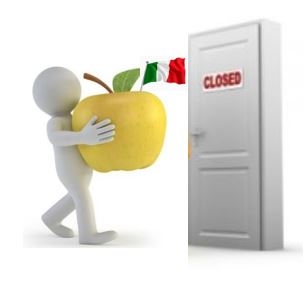
Not much has changed for Italian apple producers since last year’s Asia Fruit Logistica as far as their continued search for new markets is concerned, but there’s a potential dark cloud ahead. The lack of alternatives was not noticed in 2017/18, but this was only because Italy – like other major European supplier countries – saw its production fall dramatically due to some really bad weather, meaning it gave priority to the domestic market, plus a few neighbouring and traditional ones. A return to full production this season, however, will clearly influence its commercial results.
Italy is currently engaged in bilateral negotiations to gain market access to Vietnam and Taiwan for its apples. Last autumn, phytosanitary officials from each country spent a week touring Italian production areas, accompanied all the way by producers, technicians and regional representatives as they carried out inspections. A year on from those visits in the Vietnamese case, Italian producers are still having to field questions, some of them difficult to justify, from their counterparts; as for Taiwan, they are yet to receive any feedback from the country’s authorities. During the summer, technical documentation was sent to begin negotiations with Thailand, and in this case we also expect feedback and look forward to making progress.
In short, the process is extremely tiring and rather slow. Those directly involved believe it’s essential to receive greater support from the Italian authorities, who are well aware of the enormous potential such countries hold and of the Italian companies’ ability to tackle such demanding markets thanks to superior organisation and the range of products they offer.
Since the closure of the Russian market, something which has affected the European apple industry in particular, Italian apples have not managed to reach any new country. Indeed, key markets have been lost across North Africa, which is precisely what worries producers most for the coming season. In 2011/12 Italy exported a maximum of 53,159 tonnes of apples to Russia, compared with the 230,000 tonnes it shipped to its main North African markets in 2014/15.
Of course, the Italians have proven themselves able to react, for example by being more organised in the Far East, Brazil or India. The work done there in recent years is undeniable, but to recover North African markets and open more in the east remains a priority for Italian producers. At an EU level, in general, the so-called lack of reciprocity continues to weigh heavily: to export a product outside the EU, individual member states have to carry out bilateral negotiations for each specific product; in contrast, non-EU countries that want to sell into the EU have to negotiate access conditions just once, rather than 28 times, directly with Brussels. The EU is not recognised as a single entity, yet acts like one.
In fact, negotiations carried out by the EU on behalf of all member states – or at least those who specifically export apples – are deadlocked. Talks with the US, which was considering the elimination of pre-clearance, have ground to a halt since the Trump administration took charge, while those with Chile and Mexico are proceeding slowly and not without a hitch, compounding doubts about the strategic nature of these countries for European and Italian producers.
Giulia Montanaro for Eurofruit
http://www.fruitnet.com/eurofruit/article/176284/lack-of-alternatives-a-concern-for-italian-apples
1'190'601'950
Euro
Fatturato
2'262'878
ton.
Conferimento 2016
27'570
ha
Area
14'260
Soci produttori
Chi Siamo
ASSOMELA è l'associazione dei produttori di mele Italiani, che rappresenta, attraverso i suoi membri ca.l'80% della produzione melicola nazionale ed il 20% di quella europea.
I soci di Assomela rappresentano tutte le principali aree produttive italiane: le loro sedi si trovano infatti in 5 regioni e in 2 province autonome.
Ad Assomela si associano le OP VOG (Marlene), VI.P (Val Venosta) e VOG Products della Provincia di Bolzano, Melinda, "La Trentina" e Mezzacorona della Provincia di Trento, Melapiù della Regione Emilia Romagna, Rivoira e Lagnasco della Regione Piemonte, Melavì della Regione Lombardia e Friulfruct della Regione Friuli Venezia Giulia.
Assomela vuole essere il punto di riferimento per i produttori di mele italiani. Questi i nostri principali obiettivi:
* Rappresentare gli interessi dei soci a livello nazionale ed Europeo;
* Mantenere relazioni istituzionali a livello nazionale e sovranazionale per monitorare lo sviluppo della legislazione che potrebbe impattare sul settore;
* Tenere costantemente aggiornati i soci creando posizioni comuni sugli interessi condivisi;
* Gestire ed organizzare i dati relativi alla produzione e alle giacenze mensili;
* Supportare l'accesso ai nuovi mercati;
* Coordinare ed implementare i programmi di promozione cofinanziati dall'Unione Europea.
Soci
ASSOMELA ? l'associazione dei produttori di mele Italiani, che rappresenta, attraverso i suoi membri ca.l'80% della produzione melicola nazionale ed il 20% di quella europea.



















CONTATTI
ASSOMELA
Societ? Cooperativa
Associazione Italiana Produttori di mele
Via del Brennero, 322
38121 Trento (Italia)
E-mail: info@assomela.it
Tel: +39 (0) 461 829323 Fax: +39 (0) 461 829395
